Why Scoring is Needed for Unconfirmed Bitcoin Transactions
Bitcoin has three major properties: It is a store of value, public ledger and a payment mechanism.
Right now, Bitcoin’s ability to be a payment mechanism lacks a degree of assurance. This is because of problems with the network’s ability to securely facilitate fast transactions.
A fast transaction is where the exchange of goods or services for Bitcoin is not yet confirmed on the blockchain. Reliable blockchain confirmation is generally considered confirmed 6 to 10 times, which does not complete in less than an hour.
Consider Bitcoin brick and mortar or e-commerce merchants. In these instances, a transaction must complete in a much smaller timeframe – often under a minute.
This interval of time is nothing close to the 6 confirmations for complete confirmation on the blockchain.
Depending on hash rate, it can take 6 block confirmations to obtain 99% likelihood a transaction in a block will not be taken out of the blockchain. With 10 confirmations, the percentage can go up to 99.999%. On average this can take up to 100 minutes, which is problematic.
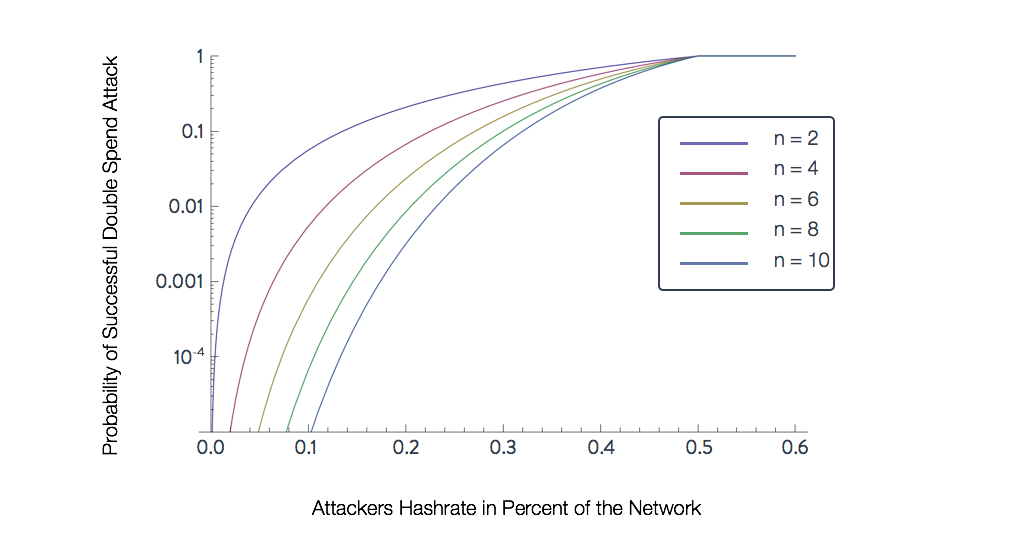
Probability of successful double spending lowers as number of confirmations increases. | source: https://bitcoil.co.il/Doublespend.pdf
Immediate analysis on the Bitcoin blockchain for fast transactions is essential because it provides a greater level of transaction confidence. This is why scoring fast transactions with blockchain data is significant for Bitcoin as a payment method.
For example, a merchant may accept many Bitcoin payments with an understanding that the scale and frequency of loss is an acceptable risk.
However, stakeholders accepting numerous transactions or receiving large amounts of Bitcoin at a point of sale can present significant concern. There still isn’t community consensus what to do about this fast transaction issue.
As a result, transactions having less than 6 confirmations, under the one-hour window, are marginalized to small trivial amounts – such as for coffee purchases. This is not acceptable for those wanting to use Bitcoin for fast, large volume or high value commerce.
A threat facing fast transactions is double spend attacks. This is where a malicious actor takes advantage of properties in the Bitcoin network to defraud the community by spending a value twice.
Fast transactions are highly vulnerable to double spends because they lack confirmation. This is why scoring in a sub-5 minute Bitcoin transaction window is needed – something traditional payment processors in fiat money excel at.
Coinalytics has developed a scoring system to assess the reliability of a transaction in the Bitcoin network. This is done by analyzing inputs as they appear on nodes in Bitcoin’s peer-to-peer network.
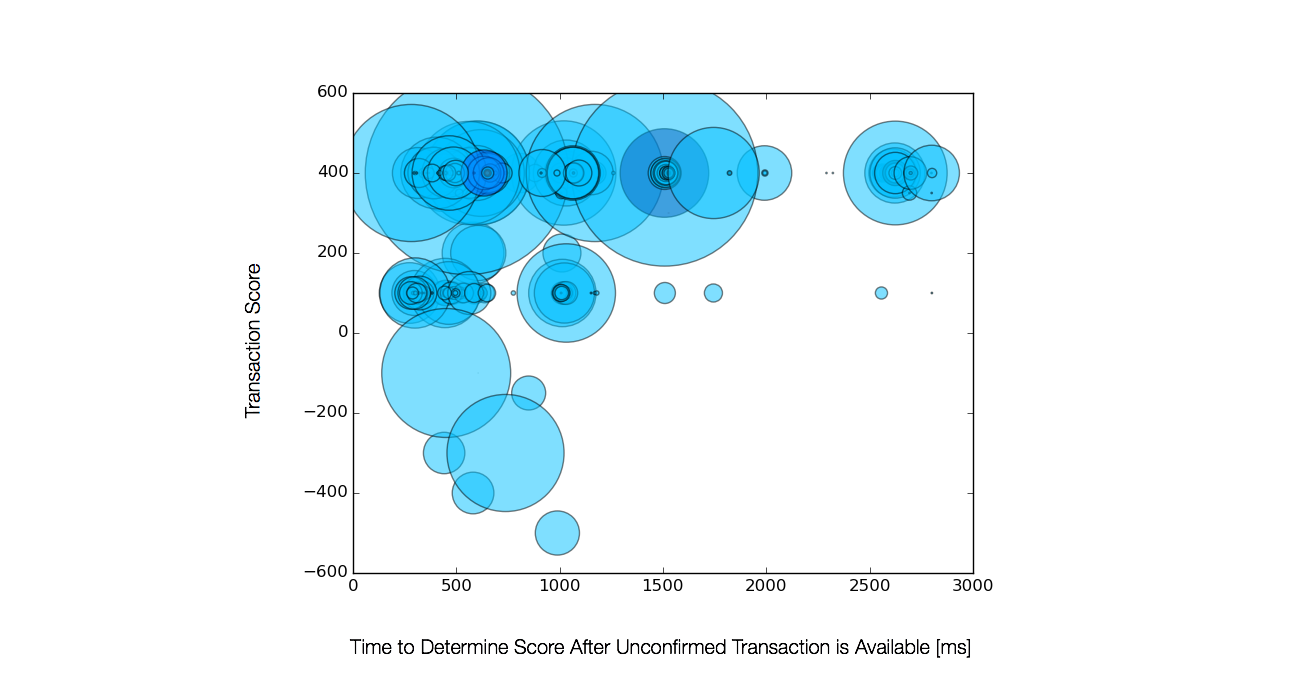
The size of circles represents transaction volume and the darker color equals higher fees. | source: Coinalytics
During a transaction, relationships between an address and prior transactions feed into the blockchain. This creates a rich and highly useful graph for analysis of transaction quality within a short time frame.
The scoring process is quick and near real-time as is possible. It consists of tracing, once a transaction starts to appear on various nodes, back at least 10 ancestors deep. Deep analysis can then find a block missing, or a transaction input spent somewhere else.
When analyzing errant transactions, as well as valid ones, there are patterns that emerge in Bitcoin’s blockchain. As a result, each new transactional input appearing on the network can be scored.
The Coinalytics scoring platform obtains transaction data and parses it immediately. Then, a score for an unconfirmed transactions are available within seconds of it appearing on the network.
Pre-block pattern identification and scoring has a lot of value for Bitcoin as a payment method. Ultimately, many Bitcoin stakeholders simply cannot wait for 6-10 confirmations for a transaction to complete. They need better transactional assurance of addresses in near real-time.
Scoring, in turn, helps service providers, merchants and individual users of Bitcoin trust fast transactions. In the end, this enables greater confidence and reliance on the blockchain.
The importance of clustering, as explained here previously, is to examine relationships from a historical perspective. For purposes of immediacy, fast transaction scoring is ideal.
Upcoming posts will demonstrate how historical clustering and real-time scoring can be used together for a more complete picture. Subscribe below to be notified of updates to our blog.